
Leave your fluorocarbon leader alone when it is undamaged, your knots are clean, your presentation is fishing correctly, and the conditions have not given you a specific reason to change it.
A slow bite does not automatically mean your leader is too heavy. A missed bite does not prove you need to go lighter. Landing a fish does not mean you need to replace perfectly good fluorocarbon.
Before changing leader size, length, or material, identify the actual problem. Check your bait or lure, knots, leader condition, hook, line management, fish behavior, and what the anglers getting bit are actually doing differently.
Sometimes a leader adjustment is exactly what the bite needs.
Sometimes the smartest move is to stop changing a setup that is already doing its job.
Key Takeaways
- Do not change fluorocarbon simply because the bite slows down.
- One missed fish or lost fish is information, not proof.
- An undamaged leader with clean knots does not automatically need replacement.
- Check presentation and rigging before blaming leader size.
- Another angler getting bit on lighter leader is useful information, not an automatic instruction.
- Clear water and pressured fish can justify a leader adjustment.
- Wide-open fishing usually gives you less reason to chase small leader changes.
- Change one variable at a time when possible.
- Once a setup is doing its job, fish it.
The school comes under the boat.
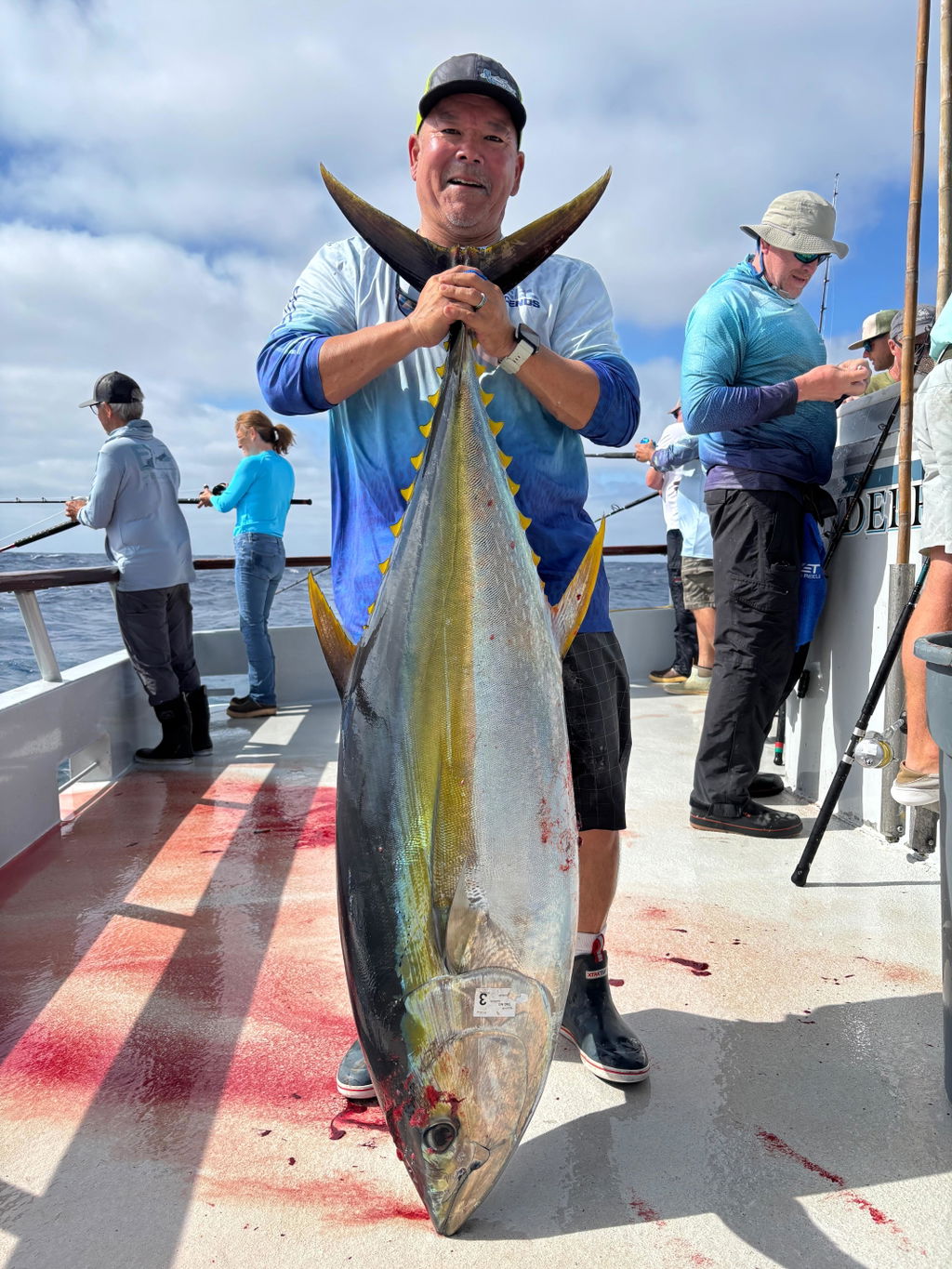
A few bluefin start boiling.
Somebody gets bit.
Then another angler hooks one.
You have not had a touch.
The rail conversation starts immediately.
“What leader are you fishing?”
“Thirty.”
“You need twenty-five.”
Five minutes later, you are cutting off a perfectly good connection.
Maybe going lighter is the right move.
But maybe your sardine never swam.
Maybe your hook is too much for the bait you're fishing.
Maybe you sent your bait into bad water.
Maybe the anglers getting bit are simply making better presentations.
Fishing gives you incomplete information.
The mistake is treating every piece of it like an instruction.
Why Do Anglers Change Their Leader Too Quickly?
Anglers often change leader too quickly because leader size is an easy variable to see and an easy variable to change.
You cannot make a school of bluefin feed.
You cannot clear the water around the boat.
You cannot make a weak sardine become strong.
But you can cut your leader off.
So that becomes the adjustment.
Thirty becomes twenty-five.
Twenty-five becomes twenty.
Six feet becomes twelve.
A perfectly good knot gets replaced.
Then the next bait still does not get bit.
Now you have changed something without learning whether it was ever the problem.
That is not adjustment.
That is guessing.
Does a Slow Bite Automatically Mean You Should Go Lighter?
No. A slow bite tells you the fish are difficult to catch; it does not tell you why.
Leader diameter may be part of the problem.
But so could:
- Weak bait
- Poor bait movement
- Hook size
- Hook placement
- Line tension
- A damaged connection
- Boat pressure
- Where your bait enters the water
- Where the fish are holding
- Timing
- The way your line is being managed
When pressured bluefin repeatedly follow presentations without committing, leader choice deserves attention.
It just does not deserve all of the attention.
Start with what you can actually observe.
What Should You Check Before Changing Your Leader?
Before changing fluorocarbon, check whether the setup has an identifiable problem that the leader adjustment would actually solve.
Ask:
- Is the fluorocarbon damaged?
- Are both connections seated correctly?
- Is the hook appropriate for the presentation?
- Is the bait swimming correctly?
- Is line leaving the reel cleanly?
- Are fish following and refusing?
- Are other anglers consistently getting bit?
- Are they actually fishing lighter leader?
- Are they also doing something else differently?
- Has the water clarity changed?
- Has boat pressure increased?
- Has the grade or behavior of the fish changed?
Those questions give you something better than:
I haven't been bit, so I'll go lighter.
When Is Your Current Fluorocarbon Leader Already Doing Its Job?
Your current leader is doing its job when it is clean, properly rigged, appropriate for the conditions, and not interfering with the presentation you need.
That does not mean you have to be hooked up every five minutes.
Fishing does not work that way.
You can make a good presentation to fish that simply do not eat.
You can fish the correct leader and have your bait swim the wrong direction.
You can do almost everything right and watch the angler beside you get the bite.
Do not confuse the outcome of one cast with the quality of the entire setup.
Look for patterns.
Is One Missed Bite Enough Reason to Change Your Leader?
No. One missed bite usually does not give you enough information to identify the leader as the problem.
The fish could have missed the hook.
The bait could have turned.
You could have reacted too early.
The fish could simply have changed direction.
One event can tell you to pay attention.
Repeated events start telling a story.
If fish consistently follow your bait and turn away while comparable presentations on a smaller-diameter leader get eaten, now you have useful information.
That is different from making a major change because one fish boiled behind your sardine.
Should You Change Leader Because Another Angler Is Getting Bit?
Use another angler's success as information, not an instruction.
If one angler is getting picked up repeatedly, pay attention.
What leader are they fishing?
But also:
What hook?
What bait?
How is that bait swimming?
Where are they casting?
How much tension are they putting on the line?
How quickly are they getting away from the boat?
Are they fishing the same depth?
The leader may be part of the answer.
Do not assume it is the entire answer.

Alan Bierig looks at that situation from the presentation outward. On a slow offshore bite, matching another angler's leader size does not mean you have matched the presentation that is getting eaten.
“On a slow bite, I watch the bait before I start blaming the fish. If one sardine is pulling line and another one is hanging under the corner, those are not the same presentation even if both guys say they're fishing the same setup.”
— Alan Bierig, Co-Owner & Long-Range Angler, Opsin Fluorocarbon
That is the distinction worth carrying to the rail.
If the angler beside you is fishing 25-pound leader and you are fishing 30, that difference deserves attention.
But first look at what is happening at the end of both setups.
If his sardine is pulling line and yours is hanging close to the boat, cutting off five pounds of leader may not solve the real problem.
Copy the information, not automatically the setup.
When Does Going Lighter Actually Make Sense?
Going lighter makes sense when the evidence suggests your current leader is interfering with the presentation required to get bit.
That evidence becomes stronger when several things line up.
The water is clear.
Boat pressure is building.
Fish are still present.
They are following without committing.
Other anglers making comparable presentations on smaller-diameter leader are consistently getting bites.
Now stepping down becomes a deliberate adjustment.
Make the smallest useful change.
Then watch what happens.
Do not turn one leader change into five other changes at the same time.
If you change the leader, hook, leader length, bait presentation, and drag together, you will have no idea which adjustment mattered.
When Should You Definitely Replace the Leader?
Replace or retie fluorocarbon when its physical condition or connection gives you a reason not to trust it.
That is different from changing leader because you want more bites.
Look for:
- Abrasion
- Nicks
- Rough sections
- Hard kinks
- Flattened sections
- Damage beside a knot
- Poorly seated knots
- Damage from crossed lines
- Contact with kelp, rocks, the hull, or other structure
Physical damage gives you a concrete reason to act.
Do not negotiate with a damaged section because the fish are biting.
Fix it.
Does Landing a Fish Mean You Should Replace Your Leader?
No. Landing a fish does not automatically make an undamaged leader unusable.
Inspect it.
Start at the hook.
Check the knot.
Run your fingers over the working section.
Think about where the fish went during the fight.
Check the braid-to-leader connection if you're fishing one.
If everything comes back clean, there may be nothing to fix.
If you feel abrasion or find damage, address it before sending the setup again.
Condition matters more than ritual.
When Should You Leave Your Leader Alone During a Wide-Open Bite?
If fish are feeding aggressively and your setup is landing them cleanly, there is usually little reason to make unnecessary leader changes.
Bluefin are charging.
Yellowtail are eating chum.
Dorado are racing each other to presentations.
Your current leader is appropriate.
Your connections are clean.
You are getting bit.
Keep fishing.
This is where anglers sometimes create problems by trying to optimize a setup that does not need optimizing.
A wide-open bite is not the time to spend ten minutes rebuilding a clean connection because somebody three spots down is fishing a different number.
Get back in the water.
What About Clear Water and Pressured Fish?
Clear water and sustained fishing pressure give you more reason to examine leader presentation, but they still do not make lighter leader an automatic answer.
Technical bites increase the value of details.
Leader diameter can matter.
Suppleness can matter.
Leader length can matter.
A clean knot can matter.
So can bait movement.
The important word is can.
You are looking for the detail that is currently limiting the presentation.
If your leader is already appropriate, changing it simply because the water is clear may not improve anything.
Can Going Too Light Create a New Problem?
Yes. Going lighter can improve presentation in some situations while reducing the strength or abrasion margin available for the fight.
Every leader decision is a tradeoff.
Imagine yellowtail holding near kelp.

Going lighter might help a difficult fish commit.
But once that fish turns toward structure, you may wish you had more margin.
Bluefin create a different version of the same decision.
You still have to get the bite.
Then you have to finish the fight.
The goal is not to fish the lightest leader possible.
It is to fish the leader that makes sense for both sides of the problem.
Should You Change Leader Size After Losing a Fish?
Not until you understand why the fish was lost.
Where did the failure happen?
Did the leader break in the middle?
Did a knot fail?
Was there abrasion?
Did the hook pull?
Did the main-line connection fail?
Did the fish reach structure?
Was the drag appropriate?
A lost fish does not automatically mean the leader was too light.
Going heavier will not repair a bad knot.
Going lighter will not repair bad bait presentation.
Find the failure before prescribing the solution.
Why Is Changing One Variable at a Time So Important?
Changing one variable at a time gives you a better chance of learning what the fish are responding to.
Suppose the bite gets difficult.
You go from 30-pound leader to 25.
You also change hooks.
Then you lengthen the leader.
Then you grab a different rod.
Your next bait gets bit.
What did you learn?
Not much.
Fishing is never a controlled laboratory experiment, but you can still avoid making the information worse.
Make the most logical adjustment.
Fish it.
Watch what happens.
Then decide whether another change is justified.
How Do You Know When to Stop Adjusting?
Stop adjusting when the setup is fishing correctly and the changes are no longer solving a specific problem.
This is harder than it sounds.
Anglers like doing things.
Retie.
Change hooks.
Change leader.
Change length.
Change rods.
Sometimes the better decision is to send another bait.
If the leader is clean, the connections are good, the presentation is right, and the setup matches the conditions, let it fish.
Do not turn preparation into procrastination.
Where Does Opsin Fluorocarbon Fit?
Opsin Fluorocarbon gives you consistent leader material to work with; deciding whether the leader needs to change still belongs to the angler.
Opsin is 100% PVDF and slow-extruded in Japan, with cloud-free clarity and a supple finish.
Those characteristics give the angler a consistent starting point when building a leader system around knot strength, abrasion resistance, and clean presentation.
But fluorocarbon cannot tell you why you missed a bite.
It cannot tell you whether the fish that broke off found kelp.
It cannot tell you whether another angler got bit because of leader diameter or because his sardine swam better.
That is fishing.
The material should perform its job.
The angler still has to read what is happening.

That is also the right way to think about premium fluorocarbon in general. It should give you dependable material when leader performance becomes important without turning the product into the explanation for every bite.
“Fluorocarbon is not a shortcut. It is a tool. When the bite is wide open, you can get away with a lot. When it gets technical, you cannot.”
— Greg Brown, Founder of Opsin Fluorocarbon
That philosophy matters when deciding whether to leave a leader alone.
If bluefin are charging everything that hits the water, fluorocarbon does not need to become the center of the conversation.
If the bite slows, the water clears, fish start following without committing, or your presentation begins showing problems, then the details deserve more attention.
Even then, fluorocarbon is still a tool.
The angler has to decide whether the leader is actually the variable that needs to change.
Quick Checklist: Should You Change Your Leader?
Before cutting off a clean leader, ask:
- Is the leader damaged?
- Is either knot questionable?
- Is the bait or lure fishing correctly?
- Are fish actually refusing the presentation?
- Has the water become clearer?
- Has boat pressure increased?
- Are other anglers consistently getting bit?
- Are they actually fishing a different leader?
- Is leader diameter the most likely difference?
- Would going lighter compromise abrasion margin you need?
- Would going heavier solve a real fight problem?
- Can you make one small adjustment instead of several?
- Is your current setup already working?
If number 13 is yes, consider doing something anglers sometimes forget:
Leave it alone and fish.
FAQ
Should I change my fluorocarbon leader when the bite slows down?
Not automatically. A slow bite can result from fish behavior, bait quality, hook choice, presentation, boat pressure, water conditions, or other factors. Change the leader when you have a specific reason to believe it is limiting the presentation.
When should I go to a lighter fluorocarbon leader?
Consider going lighter when fish are pressured or consistently refusing presentations and the evidence suggests your current leader is part of the problem. Make the smallest useful adjustment rather than dropping several leader sizes immediately.
Should I replace fluorocarbon after every fish?
No. Inspect it after the fight. Replace or retie when you find abrasion, hard kinks, nicks, knot damage, or another reason not to trust the connection.
Should I copy the leader size of the angler getting bit?
Use that angler's leader size as information. Also look at bait quality, hook choice, casting position, line management, leader length, and presentation before assuming leader size is the entire reason.
Can fluorocarbon leader be too light?
Yes. Going lighter can reduce the strength or abrasion margin available during the fight. This becomes especially important around kelp, structure, better-grade fish, or situations involving prolonged pressure.
Should I go heavier after losing a fish?
Not automatically. Identify why the fish was lost first. A knot failure, hook pull, abrasion, structure contact, or drag problem may require a different solution than increasing leader strength.
Is it bad to keep changing your fishing setup?
It can be. Changing several variables at once makes it difficult to understand what is helping or hurting the presentation. Make deliberate changes for specific reasons.
Final Takeaway
Anglers spend a lot of time learning when to change things.
There is another skill worth learning:
Knowing when not to.
A slow bite does not automatically mean lighter leader.
A big fish does not automatically mean heavier leader.
A landed fish does not automatically mean fresh leader.
And one missed opportunity does not automatically mean your setup was wrong.
Look at what the fish are doing.
Look at what your presentation is doing.
Inspect the leader.
Inspect the connections.
Then change something when the evidence gives you a reason.
If the setup is clean and doing its job, stop cutting knots.
Send another one.
Change what the fishing tells you to change. Leave the rest alone.
Opsin Gets You Bit.