
When you hook a giant bluefin, the priorities shift toward tackle capacity, dependable connections, abrasion resistance, drag management, fighting technique, and avoiding preventable failures during a long fight.
But an 800-plus-pound bluefin does not prove that fluorocarbon caught the fish. The angler still has to make the right decisions, and the entire tackle system has to work together. On fish this large, your leader is one part of a much bigger chain.
Key Takeaways
- Giant bluefin put the entire tackle system under sustained pressure.
- Getting the bite and surviving the fight are two different problems.
- Heavy leader does not compensate for a poor knot or damaged connection.
- Inspect every connection before fishing heavy tackle.
- Drag management and fighting technique matter as much as terminal tackle.
- Abrasion becomes increasingly important during prolonged fights.
- Do not use a giant tuna photo as proof that one piece of gear caught the fish.
- Fluorocarbon is part of the system—not the hero.
There are fish you catch.
And then there are fish that make everything around them look small.
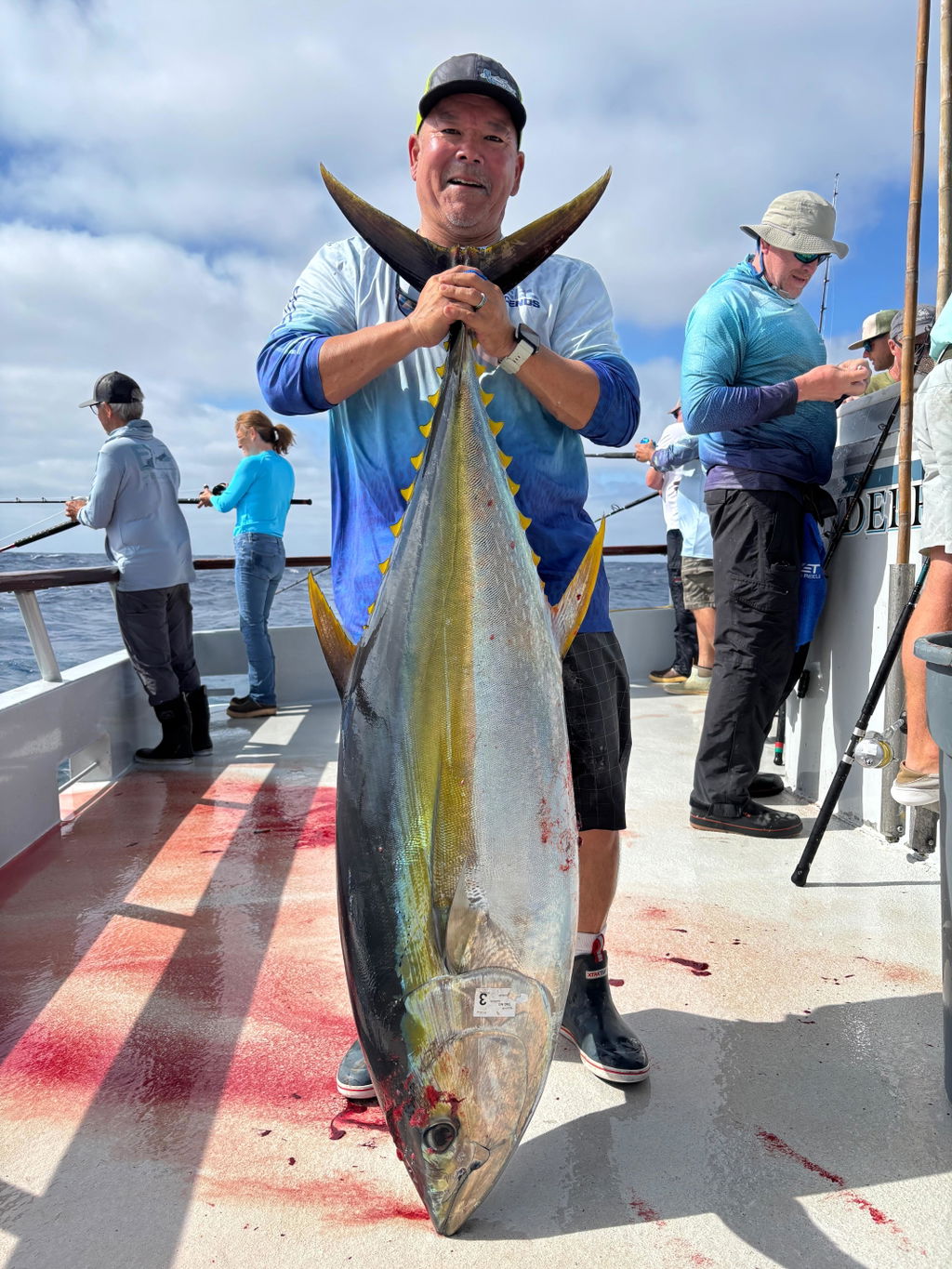
An angler standing behind a bluefin pushing hundreds of pounds tells that story immediately.
The shoulders.
The tail.
The sheer depth of the fish.
Put an 800-plus-pound bluefin in the frame and nobody needs a paragraph explaining that this is a different class of animal.
But the photograph can also create the wrong lesson.
It is easy to look at a giant tuna and immediately ask:
What leader caught it?
What knot?
What pound test?
What brand?
Those questions matter.
They are just not the whole story.
A fish that large exposes the entire system.
Why Is Fighting a Giant Bluefin Different?
A giant bluefin increases the duration, load, heat, abrasion, and physical demands placed on the entire tackle system.
A smaller tuna can still punish bad rigging.
A giant gives bad rigging more opportunities to reveal itself.
The fight can involve sustained drag pressure, long runs, changing angles, heavy circles, and extended periods with the rod and connections under load.
That changes what you should be thinking about.
Not:
“Is my fluorocarbon strong?”
But:
“Is every part of this system ready to work together?”
Your rod matters.
Your reel matters.
Line capacity matters.
Drag matters.
Main line matters.
Connections matter.
Leader matters.
Hook matters.
And the person holding the rod matters a lot.
The bigger the fish, the less useful it becomes to credit one component.
Does Giant Bluefin Mean You Should Always Fish the Heaviest Leader Possible?
No. Giant fish increase the consequences of fishing too light, but leader choice still has to account for how you are trying to get the bite.
This is one of the hardest tradeoffs in tuna fishing.
You want enough material and abrasion resistance for what may happen after the hookup.
But first, you need a fish to eat.
That distinction matters because bluefin do not always behave according to their size.
A very large fish can still be part of a selective bite.
Clear water can still matter.
Boat pressure can still matter.
Bait movement can still matter.
The presentation that gets inspected by a giant bluefin still has to get through the inspection.
That does not mean you should chase giant fish with tackle that leaves no margin.
It means getting bit and landing the fish have to be considered together.
Why Is Getting the Bite Only Half the Problem?
Getting a giant bluefin to eat solves the presentation problem; landing it begins an entirely different test.
Before the bite, you are thinking about things such as:
- Bait condition
- Presentation
- Hook choice
- Leader
- Water clarity
- Fish behavior
- Fishing pressure
- How naturally the bait is moving
After the bite, priorities change.
Now the system has to survive.
The leader may spend a long time under load.
The knot cannot gradually become the weak point.
The hook has to remain secure.
The reel has to manage sustained pressure.
The angler has to stay technically sound when fatigue starts changing how everything feels.
That is why a giant tuna photo should represent more than strength.
It represents a chain of decisions that held together.
What Does a Giant Bluefin Actually Test?
A giant bluefin tests consistency across the entire setup rather than one isolated piece of tackle.
| Part of the System | What the Fight Demands |
|---|---|
| Rod | Appropriate lifting power and controlled pressure |
| Reel | Capacity, smooth operation, and dependable drag |
| Main line | Appropriate strength and condition |
| Main-line connection | Clean, properly seated connection |
| Fluorocarbon leader | Appropriate strength, abrasion resistance, and clean condition |
| Leader knot | Proper seating and dependable knot strength |
| Hook | Appropriate size, strength, and secure connection |
| Drag | Controlled pressure rather than random adjustment |
| Angler | Technique, patience, positioning, and decision-making |
Look at the table again.
Fluorocarbon gets one row.
That is where it belongs.
Important.
But not responsible for everything else.

Why Does Abrasion Matter More During a Long Tuna Fight?
Long fights create more opportunities for the leader to experience contact, repeated loading, and changing angles, making leader condition increasingly important.
A connection does not experience one moment of pressure and then get a break.
The fish runs.
It settles.
It circles.
The angle changes.
The fish comes closer.
Then it takes line again.
On a truly large tuna, that cycle can keep repeating.
Depending on the fight, the leader may also encounter contact near the fish or boat.
Abrasion resistance helps.
It does not make fluorocarbon immune to damage.
That is an important distinction whether you are fishing a 100-pound tuna or staring at a fish several times that size.
Does a Stronger Leader Fix a Weak Knot?
No. Increasing leader strength does not correct a poorly tied, poorly seated, or damaged connection.
Heavy tackle sometimes gives anglers false confidence.
The number gets bigger.
The spool looks heavier.
Everything feels substantial.
But a connection still has to be tied correctly.
Before fishing a heavy bluefin setup, inspect the finished knot rather than simply pulling hard and deciding it must be good.
Look at how it seated.
Look at the material around it.
Make sure nothing is pinched, crossed, damaged, or obviously wrong.
A giant tuna is a bad place to discover the connection was questionable before the bait ever went in.
“On a big fish, I don't want one part of the setup doing all the work. The rod, drag, line, leader, knots, and angler all have to work together. One weak connection can erase everything you did right before it.”
— Alan Bierig, Co-Owner & Long-Range Angler, Opsin Fluorocarbon
Why Does Drag Management Matter on Giant Bluefin?
Drag management matters because a giant tuna can keep the entire system loaded for far longer than a short fight.
More drag is not automatically better.
Less is not automatically safer.
The right pressure depends on the tackle, connections, fish, angle, and stage of the fight.
This is where experience becomes difficult to replace with a number from an article.
A capable angler reads what the fish is doing.
They understand the equipment.
They know when pressure is helping and when forcing the issue creates unnecessary risk.
Fluorocarbon cannot make that decision.
Neither can the label on the spool.
Why Does Angler Technique Matter More as the Fight Gets Longer?
As a fight gets longer, efficient technique becomes increasingly important because fatigue can lead to poor angles, inconsistent pressure, and bad decisions.
Everybody looks strong during the first run.
The interesting part comes later.

When your back is tired.
When your hands hurt.
When the fish settles into another circle.
When gaining a few feet starts feeling expensive.
That is when technique matters.
Good anglers use the tackle rather than simply fighting against it.
They maintain pressure without turning every moment into a test of maximum strength.
They pay attention to what is happening instead of getting trapped by the size of the fish.
The fish may be extraordinary.
The fundamentals still matter.
What Can an 800-Plus-Pound Bluefin Photo Actually Teach You?
A giant bluefin photo is most useful when it illustrates the scale of the challenge rather than pretending to prove the superiority of a particular product.
This matters for Opsin.
If an angler catches an 800-plus-pound bluefin and we show that fish, the photo should celebrate the angler and the catch.
It should not become:
“Look what fluorocarbon did.”
The angler earned that photograph.
So did the crew.
So did everyone who helped turn a giant fish from a hookup into a landed fish.
The product's role should remain credible.
If Opsin was actually used on the catch and that fact is verified, say so accurately.
If leader size, knot, tackle, location, or fight details are not verified, do not invent them from the photograph.
A giant fish is evidence of a giant fish. Everything else needs its own evidence.
Does Giant Tuna Change How You Should Think About Leader Diameter?
Giant tuna make strength and durability increasingly important, but diameter should still be considered as part of the complete presentation rather than in isolation.
This is where simplistic advice fails.
“Always go heavier.”
“Always go smaller.”
Neither is useful without conditions.
For a technical live-bait bite, leader profile and bait movement can matter.
For a heavy presentation where the fish are feeding aggressively, the priorities may be different.
And when you move outside leader sizes where direct diameter comparisons are supported, avoid pretending one brand automatically has a smaller diameter than another.
Fish the actual specification.
Fish the actual conditions.
Fish the actual problem.
When Does Presentation Still Matter With Giant Bluefin?
Presentation matters whenever the fish are selective enough to inspect or refuse what you are offering, regardless of how large they are.
Size does not make a tuna automatically careless.
A giant fish can still swim through clean water.
It can still encounter heavy boat pressure.
It can still see dozens of baits.
It can still ignore a weak sardine.
And it can still refuse a presentation that does not look right.
That is where the familiar rule comes back:
Start with the bait.
Check the hook.
Manage line tension.
Make a clean connection.
Then decide whether leader choice is actually one of the variables worth changing.
Opsin's current bluefin guide makes the same distinction: leader selection should follow the presentation and conditions rather than simply the size of the tuna.
What Should You Check Before Fishing Heavy Bluefin Tackle?
Before fishing for giant bluefin, inspect the entire system from reel to hook instead of treating the leader as the only critical connection.
Check:
- Main line condition.
- Line capacity.
- Main-line connection.
- Leader condition.
- Leader length for the presentation.
- Every knot.
- Hook condition and strength.
- Drag operation.
- Rod and reel setup.
- Any obvious abrasion or damage.
- Whether the tackle matches the technique.
- Whether the setup makes sense for the fish and conditions.
Then stop looking for problems and fish.
Preparation should build confidence.
Not hesitation.
Where Does Opsin Fluorocarbon Fit Into Giant Bluefin Fishing?
Opsin Fluorocarbon belongs in the connection—not at the center of the story.
Opsin is 100% PVDF fluorocarbon, slow-extruded in Japan with a supple finish and cloud-free clarity.
Knot strength, abrasion resistance, consistency, and clean presentation are useful attributes when the tackle is being asked to do serious work.
But fluorocarbon does not fight an 800-pound tuna.
The angler does.
The crew does.
The rod and reel do their jobs.
The connections have to hold.
The leader simply has to perform the job it was chosen for without becoming the reason the system fails.

That is enough.
“Fluorocarbon is not a shortcut. It is a tool. When the bite is wide open, you can get away with a lot. When it gets technical, you cannot.”
— Greg Brown, Founder of Opsin Fluorocarbon
What Should You Learn From Anglers Who Land Giant Bluefin?
Copy their preparation and decision-making before you copy a single number from their tackle.
A photograph cannot tell you everything that happened before the shutter clicked.
It does not show every adjustment.
Every knot check.
Every drag decision.
Every time the angler gained line and lost it again.
Every move around the boat.
Every decision the crew made.
That is why asking only what pound test caught the fish misses most of the lesson.
Ask better questions.
How was the fish hooked?
What presentation was being fished?
How did the conditions affect the setup?
What happened during the fight?
Where were the highest-risk moments?
What did the angler and crew do correctly?
If verified details from the actual angler are available, those answers are far more useful than guessing from a photograph.

FAQ
What leader should you use for giant bluefin tuna?
There is no single leader size appropriate for every giant bluefin situation. Leader choice should account for the presentation, fish behavior, tackle system, water conditions, abrasion risk, and how the fish are being targeted.
Should you always use the heaviest possible leader for an 800-pound bluefin?
No. The setup still has to get the bite. Giant fish increase the consequences of insufficient tackle, but leader choice should balance presentation with the strength and abrasion protection the situation requires.
Does fluorocarbon matter when fishing for giant bluefin?
It can matter as part of the terminal connection, particularly for presentation, knot performance, and abrasion resistance. But fluorocarbon cannot compensate for poor knots, inappropriate tackle, bad drag management, or poor fighting technique.
Is knot strength more important with giant tuna?
Every connection becomes important when the tackle remains heavily loaded for an extended fight. A strong leader cannot compensate for a poorly tied or damaged knot.
Does bait presentation still matter for giant bluefin?
Yes, especially when fish are pressured or selective. A giant bluefin can still refuse a weak bait or poor presentation. Fish size alone does not determine how willing the tuna will be to bite.
Can fluorocarbon guarantee you land a giant bluefin?
No. No leader material can guarantee that outcome. Tackle selection, connections, hook placement, drag management, fighting technique, fish behavior, and circumstances during the fight all contribute.
What should I check after landing a large bluefin?
Inspect the working section of leader, knots, hook, main-line connection, and any area that experienced contact or unusual loading. Replace or retie anything damaged before fishing the setup again.
Final Takeaway
An 800-plus-pound bluefin makes an incredible photograph.
But the best lesson is not sitting beside the fish.
It is everything that happened before the picture.
The preparation.
The bite.
The connection.
The pressure.
The decisions.
The fight.
The crew.
And the angler who kept the whole system working until the fish was finally landed.
That is the standard worth chasing.
Not a magic leader.
Not a magic knot.
Not a magic pound test.
Build the complete system. Fish the conditions. And when fluorocarbon has a job to do, give it a clean connection and let it do that job.