
Landing a giant bluefin tuna requires more than heavy tackle. Your entire system—from the hook and knots to the leader, main line, drag, rod, reel, angler, and crew—has to keep working as the fight changes.
A giant fish puts sustained load on connections, creates more opportunities for abrasion, and gives small rigging mistakes more time to become failures.
But heavier gear alone is not the answer.
You still have to get the bite.
You still have to tie clean connections.
You still have to apply the right pressure.
And you still have to make good decisions when the fish gets close to the boat.
Fluorocarbon has an important job in that system.
It is not the whole system.
Key Takeaways
- Giant bluefin test the complete tackle system, not one piece of gear.
- Getting the bite and surviving the fight are two different problems.
- Bigger fish expose questionable knots, damaged leaders, and weak connections.
- Heavy leader does not fix poor rigging.
- Longer fights create more opportunities for abrasion and changing load angles.
- Drag pressure affects every connection between the angler and the fish.
- The angler and crew still make the decisions that finish the fight.
- Fluorocarbon is an edge within a good system, not a substitute for good fishing.
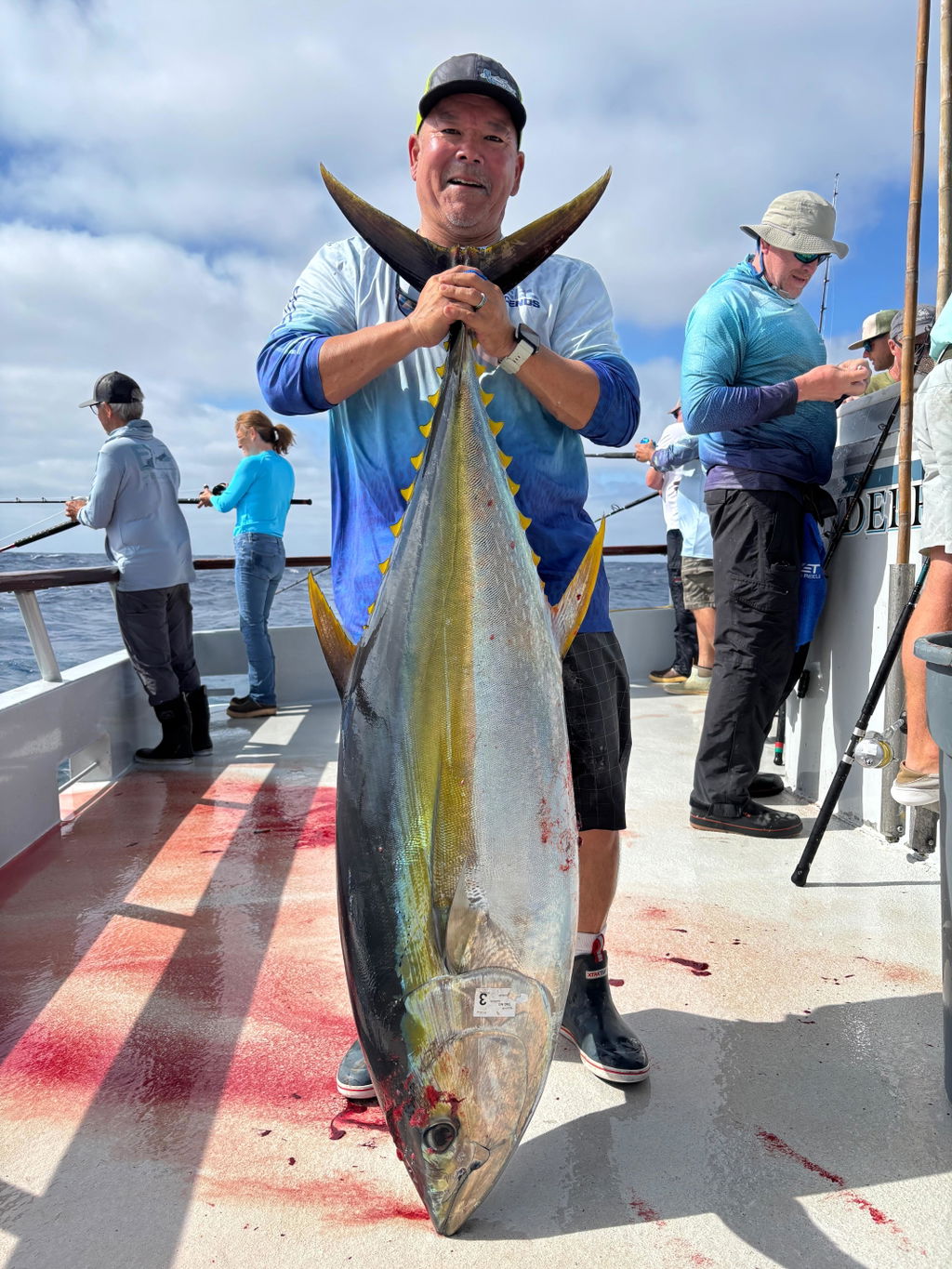
A giant bluefin hits the deck and everybody looks.
It is hard not to.
The size of the fish changes the scale of everything around it.
The rod suddenly looks smaller.
The reel looks smaller.
Even the rail looks different with a fish like that lying beside it.
Then anglers start asking about the tackle.
What leader?
What knot?
How much drag?
How heavy was the setup?
Those questions make sense.
But there is a better question:
What had to go right for a fish that size to make it all the way to the boat?
Because a giant bluefin does not test one product.
It tests the entire system.
Why Are Giant Bluefin So Hard on a Fishing Setup?
Giant bluefin are difficult because sustained pressure gives every part of the setup more opportunities to be tested.
A questionable knot might survive a short fight.
A damaged section of leader might survive a smaller fish.
A poor drag setting might not immediately become obvious.
A connection that looked good enough while rigging can feel very different once a powerful fish is pulling against it.
With a giant tuna, those small problems may be asked to survive again and again.
The fish runs.
You recover line.
It runs again.
The angle changes.
The fish settles deep.
Eventually it starts circling.

Every stage puts pressure on the setup in a slightly different way.
That is why preparation matters before the bite ever happens.
What Parts of Your Setup Does a Giant Bluefin Test?
Almost everything between the hook and the angler can become part of the fight.
Think about the system in order:
Hook → hook connection → fluorocarbon leader → main-line connection → main line → reel → drag → rod → angler
Then add everything around it.
Boat position.
Other anglers.
Changing line angles.
The fish's direction.
The final circles.
Communication with the crew.
Contact with the hull or crossed lines.
A strong leader cannot make a damaged hook stronger.
A good reel cannot repair a poorly seated knot.
A perfect knot cannot prevent the angler from making the wrong pressure decision.
One weak point can erase a lot of things that went right before it.
Giant bluefin make the complete system matter.
Why Do Small Rigging Mistakes Become Bigger Problems?
A small rigging mistake becomes more important when the fish gives it more time and pressure to fail.
That does not mean every giant tuna breaks tackle.
It means there is less room for questionable preparation.
A knot that did not seat correctly is still a bad knot.
A hard kink is still damage.
A rough section of leader is still worth checking.
A connection you did not trust while rigging will not become more trustworthy because a giant tuna ate the bait.
This is one of the simplest lessons in heavy offshore fishing:
Fix the questionable part before the fish finds it.
Why Do Knots Matter So Much on Giant Bluefin?
Knots matter because the pressure generated during the fight has to pass through your connections.
Heavy leader does not remove that responsibility.

If anything, heavier tackle can make clean knot construction even more important because the system is designed to apply substantial pressure.
Alan Bierig takes a straightforward approach to questionable connections:
“A knot doesn't get a pass because it looks close enough. If something doesn't seat right, I cut it off and tie it again. I'd rather lose another minute at the rail than find the problem when a fish is pulling on it.”
— Alan Bierig, Co-Owner & Long-Range Angler, Opsin Fluorocarbon
That is not complicated advice.
It is also exactly the kind of discipline that matters when opportunities are limited.
You might wait hours for the right bite.
Spending another minute rebuilding a connection you do not trust is cheap compared with discovering the problem under load.
If the knot looks wrong before the bite, retie it before the fish makes the decision for you.
Does a Giant Bluefin Automatically Mean You Need the Heaviest Leader Possible?
No. Fish size matters, but the heaviest leader you can tie on is not automatically the best leader for the fishing in front of you.
The first problem is still getting bit.
That matters because giant bluefin can show up during very different types of fishing.
Sometimes the fish are aggressive.
Sometimes they are around the boat but difficult to fool.
Sometimes bites are coming steadily.
Sometimes one opportunity every hour feels productive.
Those conditions affect the leader decision.
If the fish are eating aggressively and a heavier leader does not interfere with the presentation, additional strength and abrasion margin may make sense.
If the bite becomes technical, presentation may force a harder decision.
Alan Bierig puts the emphasis on the bite rather than simply the size of the tuna:
“The biggest mistake I see is anglers choosing leaders based only on the size of the fish. Most of the time, the bite tells you far more than the tuna do.”
— Alan Bierig, Co-Owner & Long-Range Angler, Opsin Fluorocarbon
That does not mean ignoring the size of the fish.
It means balancing two problems.
You need enough presentation to earn the bite and enough system to have a realistic chance of finishing the fight.
Why Is Getting the Bite Only Half the Job?
Getting a giant bluefin to eat starts the fight; it does not solve it.
This is where leader decisions get interesting.
On a difficult bite, a cleaner presentation may help remove one reason for a fish to refuse.
Once that fish eats, however, the leader has a different job.
Now it has to survive the fight.
The fish may run hard.
It may stay deep.
It may change direction.
The fight may last long enough for abrasion and changing angles to become increasingly important.
That is why the right leader decision cannot be based only on stealth or only on strength.
Both sides matter.
The best leader is not automatically the lightest leader that gets bit or the heaviest leader you can fish. It is the leader that makes sense for the bite and the fight.
Why Does Leader Condition Matter More During a Long Fight?
Long fights create more opportunities for the working section of leader to experience abrasion, friction, and changing load angles.
The leader may come through perfectly clean.
Or something may happen along the way.
The fish changes direction.
Another line crosses yours.
The leader approaches the hull.
The fish reaches the final circles.
The angle becomes steeper.
That is where abrasion resistance earns its place in the conversation.
But abrasion resistance does not mean abrasion-proof.
No fluorocarbon should be treated that way.
Good material gives you margin.
The angler still has to inspect it.
If you find a rough section, nick, flattened area, or hard kink after a fight, do not ignore it because the leader just landed a fish.
Its condition has changed.
Treat it accordingly.
Why Does Drag Management Matter on a Giant Tuna?
Drag matters because every pound of pressure applied to the fish also travels through the hook, knots, leader, main line, reel, and rod.
More drag is not automatically better.
Less drag is not automatically safer.
The appropriate pressure depends on the tackle and what is happening during the fight.
A fish running away from the boat presents one situation.
A fish straight underneath the boat presents another.
A fish settling into deep circles changes the geometry again.
The tackle gives the angler the ability to apply pressure.
It does not decide how that pressure should be used.
That still belongs to the person holding the rod.
What Changes When the Fish Gets Close to the Boat?
The end of the fight can expose problems that were not obvious when the fish was far away.
The angle gets steeper.
The fish may begin circling.
The leader may become more involved in the fight.
The boat becomes part of the environment around the line.
There may be other anglers nearby.
There may be crossed lines.
The fish may make another run when everyone thought the fight was almost finished.
This is not the time to stop paying attention because the fish is finally visible.
A lot still has to go right.
Keep the line clear.
Listen to the crew.
Stay aware of the angle.
Keep applying useful pressure.
And do not turn the last few minutes into a race.
Close is not landed.
Can Better Gear Make Up for Poor Fighting Technique?
No. Better gear can provide more capability and margin, but it cannot make decisions for the angler.
A premium leader cannot choose the right drag pressure.
A strong knot cannot move the angler around the rail.
A good reel cannot keep another line from crossing yours.
A rod cannot decide when to gain line.
That is why giant bluefin are such a good reminder of what tackle actually does.
It supports the angler.
It gives good decisions a better chance to work.
It does not replace those decisions.
Fluorocarbon is the same.
It has a job.
Let it do that job without asking it to take credit for everything else.
What Should You Check Before Fishing for Giant Bluefin?
Before fishing heavy bluefin tackle, inspect the complete system instead of focusing only on the number printed on the leader.
Pre-Bite Checklist
- Inspect the fluorocarbon for abrasion, hard kinks, flattening, or damage.
- Check the hook.
- Inspect the hook connection.
- Check the main-line connection.
- Make sure every knot is properly seated.
- Confirm the leader choice makes sense for the current bite.
- Check the main line for damage.
- Make sure the reel has the capacity required for the fishing.
- Confirm the drag is operating smoothly.
- Make sure the rod, reel, line, and leader work as a system.
- Rebuild any connection you do not trust.
- Once the setup checks out, stop second-guessing it and fish.
That last point matters.
Preparation should remove doubts.
It should not keep you out of the water.
What Should You Check After a Giant Bluefin Fight?
After a hard fight, inspect the parts of the system that were actually worked before sending the setup again.
Start with the hook.
Check the hook connection.
Run your fingers along the working section of leader.
Look for rough spots.
Check for hard kinks or flattening.
Inspect the main-line connection.
Think about anything the line contacted during the fight.
If the setup comes back clean, that tells you something.
If you find damage, that tells you something too.
Do not automatically replace good material.
Do not automatically reuse compromised material.
Inspect what the fish actually worked.
Where Does Opsin Fit Into Giant Bluefin Fishing?
Opsin Big Game Fluorocarbon is built to give anglers consistent leader material when the fish and the tackle demand more from the leader.
For heavy bluefin fishing, that means focusing on the characteristics that actually matter once the leader is part of the system.
Opsin Fluorocarbon is 100% PVDF and slow-extruded in Japan, with cloud-free clarity and a supple finish.
The goal is dependable material around which the angler can build clean connections, maintain abrasion resistance, and make the leader choice the conditions require.
But the product does not tie itself.
It does not inspect itself.
It does not decide whether a questionable section should be replaced.
Greg Brown describes that division clearly:
“We can control how the fluorocarbon is made. The angler still controls the connection. Good material gives you a clean starting point, but you still have to tie it right and check it.”
— Greg Brown, Founder of Opsin Fluorocarbon
That is especially relevant when the fish is big.
The material should give you a dependable starting point.
What happens from there still depends on the setup you build and how you fish it.

Fluorocarbon is part of the system. The angler still has to make the system work.
What Does a Giant Bluefin Catch Really Prove?
A giant bluefin on deck proves that enough things went right during that particular fight to finish the job.
It does not prove that one leader size is correct for every tuna.
It does not prove that one knot is the only knot worth tying.
It does not prove that fluorocarbon alone landed the fish.
What it does show is why preparation matters.
A giant fish gives every connection a job.
It gives the drag a job.
It gives the rod and reel a job.
It gives the leader a job.
And it gives the angler a lot of decisions to make.
When all of those pieces keep working together, you get the part everyone remembers:
The fish on deck.
FAQ
What leader should you use for giant bluefin tuna?
Leader choice should account for the grade of fish, fishing technique, bite conditions, tackle system, and abrasion risk. Bigger fish can justify more strength and abrasion margin, but fish size should not be the only factor.
Should you always use heavier fluorocarbon for giant bluefin?
No. Heavier leader may provide additional margin, but presentation still matters. The goal is to use a leader appropriate for both the bite and the fight rather than automatically choosing the heaviest option.
Why are knots so important for giant tuna?
The pressure generated during the fight passes through your connections. A poorly seated or damaged knot can become a weak point under sustained load, regardless of how strong the rest of the tackle is.
Does abrasion resistance matter for giant bluefin?
Yes. Long fights can create more opportunities for the leader to encounter friction, crossed lines, the hull, or other contact. Abrasion resistance provides useful margin, but the leader should still be inspected for damage.
Should you replace your leader after landing a giant bluefin?
Not automatically. Inspect the leader and connections carefully. Replace or retie when you find abrasion, hard kinks, flattening, knot damage, or another reason not to trust the setup.
Does premium fluorocarbon guarantee you will land a giant tuna?
No. Fluorocarbon is one component of the system. Knots, hooks, main line, drag, rod, reel, angler technique, and crew decisions all contribute to whether the fish reaches the boat.
What is the biggest mistake anglers make when preparing for giant bluefin?
One common mistake is focusing only on leader strength while overlooking the complete system. A heavy leader cannot compensate for a questionable knot, damaged connection, poor drag performance, or bad line management.
Final Takeaway
A giant bluefin on deck is the part everybody remembers.
But the fish did not get there because of one piece of tackle.
The fish had to eat.
The hook had to hold.
The knots had to hold.
The leader had to do its job.
The main line had to do its job.
The drag had to work.
The angler had to make decisions under pressure.
And the crew had to help finish the fight.
That is what makes a giant bluefin catch worth paying attention to.
Not because it proves one product is responsible.
Because it shows what happens when the entire system keeps doing its job against a fish capable of finding the weak point.
Prepare the whole system. Trust the parts you've checked. Then fish.
Opsin Gets You Bit.